| Dr. Swaminathan Balachandran: Topnotch engineer, educator, and community leader |
| By Heidi M. Pascual |
| is definitely one of them. Consistently at the top of his class since his high school days, "Bala," as he is fondly called by his loving wife Lalita and close friends, had known early on that education was important and that his future depended on it. His inspiration and the push to excel came from his parents. "My family was not very rich, and we knew from a very young age that education was the key to success in life," Balachandran said. "Once I reached college, I realized that I had unlimited opportunities if I did very well; and the key to success -- to really do well in life -- wherever you are, is to try to be in the top 5 to 10 percent of the people in your field." Balachandran completed his bachelor's degree in mechanical engineering and was ranked third among a thousand or so graduates in that field. He decided to pursue a master's degree in aeronautical engineering with specialization in rockets and missiles, a field that is uncommon to engineers. He explained that both degrees are related in the sense that they deal with the design of the same type of components and devices. He was immediately hired by the Indian Space Research Organization, for being one of only three civilian students who specialized in that area. "I worked for four years as a project engineer in the satellite-launch project at the Indian Space Research Organization," he recalled. "I designed the parts of the rocket vehicle that launched the Indian satellite for the first time in 1978." Specifically, Balachandran was responsible for designing the interstice structures that linked the four stages of the launch vehicle, and once designed, he had to get them fabricated at various aircraft companies or aircraft manufacturing plants in India. Still in his youth and with such an impressive background, Balachandran decided to leave India to pursue his doctorate at the Virginia Polytechnic Institute and State University (also known as Virginia Tech). Little did he know that his move would lead him to another direction: teaching. "One year after I came (to the U.S. in 1974), I got appointed as assistant professor of industrial engineering in the same field where I was graduating from," he beamed. "So, I was motivated to stay and taught for 10 years at Virginia Tech." While his motivation was great, adjusting to a new life in the u.S. was difficult, but Balachandran kept his eye on the prize. "When I came here for a doctoral degree after four years of work in the industry, that was a difficult transition for two reasons," he said. "One reason was that when I was working in India, I was supervising probably about anywhere from 5 to 10 engineers. I was a manager or project leader for a small group. So it was more of a management work at the end of four years. And I had to give up all that and start everything from scratch when I came here for higher studies. That was probably one difficult task. The second difficulty was that I had almost forgotten or been out of touch with mathematics and all the other basic foundations needed to doing doctoral degree in engineering, so I had to work long hours and put in more time and effort to maintain the 4.0 GPA in my graduate studies." As to his shift from engineering to teaching, Balachandran noted his positive experiences. "My teaching actually improved the way I speak," he said proudly. "The first time I taught in a class, I realized that there were some students in the class who could not understand me because of my accent and my British way of speaking. So I have changed that quite a bit. |
| "There is also an immediate reward in teaching in the sense that you can see some students realize at one point in time that something illuminated in their brain or mind and that they are able to understand what I'm talking about, so you get immediate gratification that you have been instrumental in helping people understand some things." |
| As to "challenging moments in the U.S.," Balachandran cited his past work as chair of the Industrial Engineering Program at UW-Platteville in 1985. "I was given the task of getting the program established and accredited by the Accreditation Board for Engineering and Technology by 1988, and I was told that if I didn't get the program accredited, then in two to three years, the program will be cancelled," he said with a vivid recollection. "(I accomplished it) by working very hard and having continued support from some of my colleagues from other universities, getting some ideas from them, of course, getting funds from many different sources to establish labs and also with the support of the dean of engineering at that time." Balachandran has been teaching at UW-Platteville since then. "I still teach at Platteville, and I've been there for 21 years," he said with pride and a sense of loyalty. "I'm one of the most senior faculty, so I enjoy my position and the respect and the other concessions I get being a most senior faculty member." While Balachandran met his wife for the first time during his 1976 wedding ceremony in India, courtesy of the traditional parental pre-arranged marriage at the time, he admitted that the union has been blessed with an ever-growing love through the years. "Falling in love takes time; it's something that grows after you get married," he said smiling, an earshot of his wife, Lalita. "So, it was not love at first sight; but I was always happy with my choice. I never regretted it." LalitaBalachandran, at the time of her marriage, completed two years of her bachelor's degree in physics. She gave up her studies, joined Balachandran in the U.S., and waited until later to complete her engineering degree from UW-Platteville. Mrs. Balachandran has been working as a Dept. of Transportation engineer for 10 years. The Balachandrans have two boys, born in 1978 and 1983. The eldest is a medical doctor who specializes in internal medicine, and works at the Northwestern University Hospital in downtown Chicago. The second is a chemical engineer who graduated from UW-Madison and is now working for an international company in Madison. In the fall he'll pursue his graduate studies at Purdue University in Indiana. |
| With the children already graduated, the couple has been busy doing community service. Asked about the most fulfilling part of the "job," Balachandran said, "Probably two different types: One is personal: that you get a lot of satisfaction by seeing that somebody or some other group benefits from your experience. The other is the sense of duty, an external one: as a person who came from outside the country and settled down, you feel that you have some duty to give something back to the community. The first one is internal, the other one is external." When asked whether or not he has any frustration at all, he gave a straightforward answer. "No, no frustration. I feel that I have achieved almost everything that I wanted to achieve professionally. I don't want to progress more than what I have done in the administration," he said. "I have been administrator for about nine years as department chair, and most of the time is lost in meetings and minutes, budgets, and so on. I have paid my dues, and I don't enjoy it that much. So, not doing administrative work gives me a lot of time and opportunities to serve my professional societies." Balachandran has now found the time to do many other work outside of the classroom which he enjoys immensely: Commissioner for Technology Accreditation Commission of the Accreditation Board for Engineering and Technology (which allows him to visit other universities to lead a team of colleagues to review technology programs and write a final report about accreditation); vice-president of Region IV of Alpha Pi Mu, an Industrial Engineering Honor Society (where he works with colleagues from all over the country); and board member, Optometry Examination Board (an appointment by Governor James Doyle). As a community leader, Balachandran is active with the Indian community, as member or officer of the following: Association of Indians in America, America Hindu Association, Wisconsin Tamil Sangam, and quite a few other Indian groupsn. "I'm trying to get some of these groups to engage in volunteer work in UW Arboretum and Adopt a Highway Program where we clean highway three times a year in the summer," he said. "We?'e also starting a few other community service activities like helping with the Madison food Pantry Gardens and also serving food as some other food pantries and churches." Busier than ever, Balachandran said, "It's nice to be busy, because in about 10 years I plan to retire, but before I retire I want to have enough number of community and other types of volunteer service activities developed completely. So I'll be as busy in retirement as I have been in my professional life." When asked what he would you say to kids and youth today, Balachandran gave the following advice: "Several different things: First, of course, is education. When you go to school, make sure that every day, you study for gaining knowledge. Study for the exam, [but] don't study things only for exams. Study for knowledge; read as much as you can. Read different types of books and learn all the subjects. Participate in extracurricular activities like Forensics Club, Science Club, Math Club, Music, school band, and sports. Because when you're in the middle school and high school, you don't really know what you're really good at. You have to try everything the school has to offer so you can find out for yourself what you're really good at. You're not going to have that opportunity in life (if you don't try). Once you go to college, you'll be more focused in one area. Then when you go to work, you'll be lot more focused in a very small area. So middle school and high school are the only places where you have opportunities to try lots of things and leave those things after a year or two if you don't like them, but try to find what really pleases you and which activities you'll excel in." In conclusion of the interview, the Balachandrans together talked about U.S,-born children of immigrants and their exposure to different cultures. "We can tell them at home as much as we can, but we have to let them go at some point and let them pick it up on their own later on, not force them completely," Mrs. Balachandran said. "Something similar to the separation of church and state in the American custom that they have to practice at home, as well," Balachandran emphasized. "Most of the kids from India or other cultures have to have their private world where they appreciate their culture and do everything to learn the culture at home, but when they do to school or work, they have to behave like Americans. Somebody has to tell them that there is nothing wrong in adopting different modes of behavior in different environments. So sometimes the kids don't want to learn their own culture because they compare it to American culture and look at it with a different feeling. They have to know that it's OK to have different modes of behavior in different contexts." |
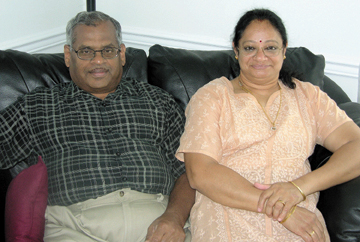 |
| Dr. Swaminathan Balachandran with wife Lalita, also an engineer |
| The Indian American community in Wisconsin boasts of so many intellectuals among its ranks, whose achievements and contributions to society extend far beyond the limits of their chosen homeland. Dr. Swaminathan Balachandran |
 |