 |
| Singapore's Thaipusam |
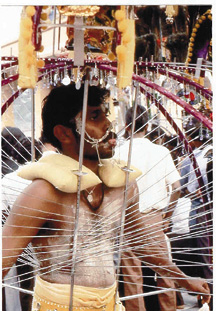 |
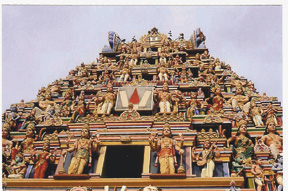
| (Left) Thaipusam celebrant wearing kavadi. His tongue is pierced with skewers through both cheeks. (Right) Perumal Temple Gate |
| By Lorin Robinson The ceremony begins before sunrise. The temple grounds are filled to overflowing as the sun starts to spill over its walls. The day is already warm. Incense pours from hundreds of burners, so thick that it swirls like fog. And amid the clamor and reverberating of racuous Indian music, the celebrants -- dressed in saffron-colored shorts -- stand serenely, waiting for their ritualistic ordeals to begin. The ceremony is Thaipusam, a Hindu observance rarely practiced anywhere today. But the location is not some remote village in India. The ceremony takes place each January or February in the Perumal Temple on Sarangoon Road, in the heart of bustling, cosmopolitan, and thoroughly modern Singapore. Thaipusam is just one of dozens of Hindu, Buddhist, and Muslim observances that make this tiny, 225-square mile island city-state such an exciting place. Virtually all the cultures, customs, and crafts of Southeast Asia may be found here. About 77 percent of Singapore's 4 million people are Chinese -- the sons and daughters of overseas Chinese who emigrated to find their fortunes in this vibrant traders' paradise at the crossroads of Asia. Another 14 percent are native Malay, and 8 percent are of Indian extraction. |
| The three main ethnic groups have been encouraged to retain their identities. Singapore has four official languages -- Mandarin, Malay, Tamil, and English -- with English as the lingua franca. And the traditions of Buddhism, Hinduism, and Islam are all actively practiced. To many people, Thaipusam may seem to be among the most bizarre of religious rituals. The celebrants, mostly young men, have vowed that, in return for a favor granted by one of the Hindu deities, they would participate in Thaipusam for 10 consecutive years. Miss a year and one starts all over again! "Participation" is a mild description of what they have agreed to put themselves through. Most penitents have heavy metal frames called kavadis placed on their shoulders, attached with hooks that pierce their skin. The kavadis are beautifully decorated with flowers, peacock feathers, and other ornamentation and carried in a two-mile procession through the blistering midday sun. In addition to carrying kavadis, most celebrants also allow metal skewers to be stuck through their cheeks, tongues, and foreheads. Fruits such as lemons or limes may also be hung from their backs or chests, attached with hooks. While these operations are performed, family and friends gather around the participants, loudly chanting encouragement. There is no sign of pain or blood during any of these preparations. Believers say this is because |
| celebrants fast and meditate to prepare themselves for the ordeal. Some cynics, on the other hand, attribute the apparent fortitude to drugs. Whatever the cause, the participants stoicism is remarkable. But stoicism seems to be the hallmark of Singapore. The tiny country has been independent only since 1965, and during its first few years, observers gave it little chance of survival, surrounded as it was by the sometimes unfriendly Malaysia and Indonesia -- countries that feared the industrious and acquistive nature of the predominantly Chinese population of the little island. Singapore not only survived, however, it has prospered to the point that its standard of living is second. In Asia, only in to Japan' Singapore has the busiest port in the world and is the commercial and communications center of Southeast Asia. |