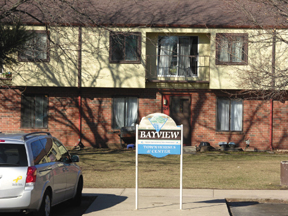
As time progressed, Jews, African Americans, Southeast Asians, and Hispanics started to fill the 102 townhouse units. Today, Bayview is a growing multicultural community with residents from African, African American, Euro-American, Vietnamese, Lao, Hmong, Chinese, Hispanic, Cambodian, and Native American backgrounds. Eighty-seven percent of the heads of households living at Bayview were born outside the United States, and at any given time, over 20 different languages are spoken in and around Bayview.
Not only do residents from all different backgrounds come to Bayview for its multicultural tradition; they also come to Bayview for other reasons. Many of them are attracted to Bayview's affordable housing and convenient location. Program Coordinator Paul Ly Tong-Pao explains that Bayview is very convenient for older residents, especially those who don't know how to drive. They can simply walk to the hospital, the store, the park, or go fishing at the lake. While some choose Bayview for its location, others just need a helping hand and a fresh start. Ly said that sometimes people just need a break and Bayview gives them that break. He also said that Bayview is a stepping stone for families who are trying to reach a bigger dream: that of owning a home. Since its opening, Bayview has noted that 47 percent of its residents who had moved out of Bayview moved into homes that they bought.
Whatever the reasons may be for moving to Bayview, residents find themselves staying there for more than just cheap rent. In addition to providing affordable housing, Bayview is committed to providing excellent human services, arts appreciation, and cultural awareness. The combination of all four goals is probably the reason why families stay there for so long. Families usually live at Bayview for three to eight years, said Haas.
But there are certainly those who have lived there much longer. The Thao family has lived in Bayview for almost 24 years.
Johnson Thao, 24, said that his parents followed relatives to Bayview and have lived there since. His 12-year-old brother, Tommy Thao, doesn't know why his family came to Bayview; all he knows is that he's lived there his whole life and he likes it there. Tommy says, "I like it here because you make a lot of good friends." Johnson adds, "It's like one big family here."
Residents are not the only ones who recognize the value of being part of the Bayview community. More and more people want to join this community, but they will have to wait their turn. There is a three-year waiting period for residency at Bayview, the longest waiting list for any Dane County low-income family housing project. When asked why people want to come to Bayview, Haas simply said, "Bayview is a neighborhood that welcomes people and targets the needs of people who live here."
In the heart of the community is the Bayview International Center for Education and Arts, known to many as just "Bayview" or "the Center." With African art, Hmong needle work, and pictures of residents adorning the walls of the center, it is easy to see the diversity and acceptance in this community. The center is where residents can go for help and be a part of the arts and cultural activities. It provides regular enrichment programs such as adult education, preschool, youth recreation, multicultural education, English as a second language, tutoring, and much more.
Perhaps one of the most important and beneficial programs provided by the center is the After School Program for youths in the community. This program consists of tutoring, one-on-one reading, homework help, computer learning, recreation, and arts and cultural learning. "The Center provides kids with a safe place to go during critical after-school hours," Education and Recreation Coordinator Teri LeSage said. "The After School Program promotes positive youth development by allowing youths to reject negative choices." Ly added that children in this community have the potential to do great things, but because their parents don't speak English or know the system, they can't help their children as much as they would like. This is where the center steps in to help guide youths in the right direction. An average of 150 kids and 80 adults regularly participate in the programs provided by the center.
Bayview not only shares its rich diversity among residents within its own community, it also holds an Annual Triangle Ethnic Fest open to the Madison community. This day of cultural entertainment, dance, food, and education is held every year during the second week of August. The Bayview parking lot is transformed into stages where cultures are shared and people come together. The festival has been known to attract over 5,000 people annually.
Although Bayview is successful in providing its residents with a safe place to live, bringing people together, and helping those in need, there is still more that could be done. LeSage said that she would like to see more programs available especially during the weekends, to which proposal Johnson Thao fully agreed. Thao added that he would also like to see programs that involve both parents and kids. Ly pointed out, however, that more space is needed at the center to include staff offices or maybe even a gym for kids. More space could provide for more activities and more quality programs, Haas concurred.
But like all nonprofit organizations, money is always an issue. Most of the money that provides for the programs at Bayview comes from residents' rent, but donations have also made a difference. Anybody can help out the Bayview community with either their time as a volunteer or with individual or corporate donations. For more information about the Bayview community, its programs, or how to donate visit bayviewfoundation.org.
It is time that this multicultural neighborhood no longer hid behind the busy downtown streets, the crazy college students and the sirens of the hospital. |