


Return to Bicycles

pedals half way down. With a horizontal bar between the seat and the front handle, I had to put my left foot on top of the left
axle to get on to the seat. To get off, I had to apply the brake and leap off from the bike at the same time.
Only when I was a teenager did I begin to ride a bike, formerly my sister Ping’s, to school. Most of the students walked,
regardless of the distance between home and school. Having a bicycle was much admired by my classmates.
I barely touched a bicycle during the four years I was in college, with my dorm, dining hall and classroom building situated
next to one another. In the four years after college when I was in Beijing, I was assigned to live in a dorm provided by the
company I worked for in the north side of the city and went to work in the company’s subsidiary in the south, all the way
across town. It was an hour-long bus ride without traffic. At that time, China was a country of bicycles. I remember reading a
newspaper cartoon titled “Driver’s View” in which a bus driver stared helplessly as the road before him was completely taken
over by cyclists. The main means of transportation, and the least expensive, was bicycling at the time, and many older
women “watched” people’s bicycles parked on the sides of the streets for two cents. Unfortunately for me, the distance was
too far to ride a bicycle. I endured motion sickness everyday on the long bus ride.
axle to get on to the seat. To get off, I had to apply the brake and leap off from the bike at the same time.
Only when I was a teenager did I begin to ride a bike, formerly my sister Ping’s, to school. Most of the students walked,
regardless of the distance between home and school. Having a bicycle was much admired by my classmates.
I barely touched a bicycle during the four years I was in college, with my dorm, dining hall and classroom building situated
next to one another. In the four years after college when I was in Beijing, I was assigned to live in a dorm provided by the
company I worked for in the north side of the city and went to work in the company’s subsidiary in the south, all the way
across town. It was an hour-long bus ride without traffic. At that time, China was a country of bicycles. I remember reading a
newspaper cartoon titled “Driver’s View” in which a bus driver stared helplessly as the road before him was completely taken
over by cyclists. The main means of transportation, and the least expensive, was bicycling at the time, and many older
women “watched” people’s bicycles parked on the sides of the streets for two cents. Unfortunately for me, the distance was
too far to ride a bicycle. I endured motion sickness everyday on the long bus ride.
Jian Ping
Jian Ping is author of “Mulberry Child: A Memoir of
China. “ For more information, visit www.moraquest.
com or www.mulberrychild.com. Jian Ping’s blog,
which she keeps with a couple of other authors, is at
www.smearedtype.com.
China. “ For more information, visit www.moraquest.
com or www.mulberrychild.com. Jian Ping’s blog,
which she keeps with a couple of other authors, is at
www.smearedtype.com.



| If you want to make a difference in the lives of our residents, visit our website to view and apply for our current openings. www.oakwoodvillage.net Oakwood Village is a Lutheran church-sponsored, not-for-profit, locally operated organization consisting of two continuing care retirement communities, Oakwood Village East and Oakwood Village West, in Madison, Wisconsin. EOE |
| Caring for older adults through compassionate and excellent service |
By Jian Ping
In the month of June in Chicago, a number of bicycle events kick off, shutting down major
streets and sending strong messages across the city to promote bicycling for transportation
and recreation, a win-win activity for both cyclists and the environment. The City of Chicago
endorses it. Former Mayor Daley formed a special council to make the city “bicycle friendly”
and the current new Mayor Rahm Emanuel has hired a transportation commissioner, who
had initiated the bicycle program in Washington D.C. and reportedly often rides his bicycle
to work now from Chicago’s South loop to City Hall.
This is all good news, for I’m a veteran bicyclist and still prefer to ride my bike running
errands to taking a cab or a bus. My love for the bike goes all the way back. As I was growing
up in the 1960s in China, it was a luxury for a family to have a bike. My mother had one and
rode it to work six days a week. I began to sneak out with her full-size Phoenix bike on
Sundays before I started elementary school. I was too small to get on the seat. But following
In the month of June in Chicago, a number of bicycle events kick off, shutting down major
streets and sending strong messages across the city to promote bicycling for transportation
and recreation, a win-win activity for both cyclists and the environment. The City of Chicago
endorses it. Former Mayor Daley formed a special council to make the city “bicycle friendly”
and the current new Mayor Rahm Emanuel has hired a transportation commissioner, who
had initiated the bicycle program in Washington D.C. and reportedly often rides his bicycle
to work now from Chicago’s South loop to City Hall.
This is all good news, for I’m a veteran bicyclist and still prefer to ride my bike running
errands to taking a cab or a bus. My love for the bike goes all the way back. As I was growing
up in the 1960s in China, it was a luxury for a family to have a bike. My mother had one and
rode it to work six days a week. I began to sneak out with her full-size Phoenix bike on
Sundays before I started elementary school. I was too small to get on the seat. But following
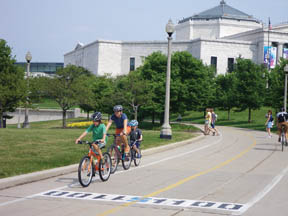
| A family of cyclists at the lakefront trail in Chicago |
the example of my older siblings, I learned first to slide with one foot
on the left pedal and once I could maintain my balance, I extended my
right leg through the triangle frame of the bike and pedaled sideway.
The bike proved to be too big for me to manage and many times I
crashed head on into wall and buildings, screaming with alarm, but
unable to stop. Once I even rode the bike into an open sewer.
However, almost every time I managed to jump off the bike just before
the crash. I still fell, but the consequence was not as bad as having a
bundle of metal piling on top of me.
Afraid to be chided by my mother, I learned to realign the bicycle by
holding the front wheel between my legs and adjusting the handlebar.
In retrospect, I’m amazed that my mother didn’t forbid me from
abusing her bike—she must have noticed the scratches on the paint
and the different feel of the handle. By the time I became a skillful rider
and could swing myself on the seat, my feet could only touch the
on the left pedal and once I could maintain my balance, I extended my
right leg through the triangle frame of the bike and pedaled sideway.
The bike proved to be too big for me to manage and many times I
crashed head on into wall and buildings, screaming with alarm, but
unable to stop. Once I even rode the bike into an open sewer.
However, almost every time I managed to jump off the bike just before
the crash. I still fell, but the consequence was not as bad as having a
bundle of metal piling on top of me.
Afraid to be chided by my mother, I learned to realign the bicycle by
holding the front wheel between my legs and adjusting the handlebar.
In retrospect, I’m amazed that my mother didn’t forbid me from
abusing her bike—she must have noticed the scratches on the paint
and the different feel of the handle. By the time I became a skillful rider
and could swing myself on the seat, my feet could only touch the
Ironically, only after I came to the United States, a country of cars, did I start riding a
bicycle again. That was in 1986. In an effort to save money, I rented a room from
Margaret, an elderly American woman who lived by herself quite far from the
university campus in Ohio where I was doing graduate studies. My professor took
pity on me and bought a used bike from a yard sale and lent it to me. The bike had
reflectors in the front and back, but Margaret insisted that I install lights, saying I
didn’t drive and didn’t realize how dangerous it was to ride on the road side by side
with fast-moving cars. To stop her nagging, I reluctantly had a set of lights installed
on the bike, costing me a fortune (I was still in the habit of converting every dollar
into Chinese currency at the time). At that time, I really didn’t have any spare money
to spend. I never turned on the light despite frequently riding late at night—there
were few cars on the road in the small college town, and the roads were well lit.
Besides, all the drivers seemed so friendly that they all steered their cars away from
me when they came up from behind. Most of the students lived close to campus,
and the hilly town was not ideal for bicycling. Even on the sprawling campus I didn’t
see many bicycles. People simply walked or drove.
After graduation, I went to work in New York City. During the five years I was there, I
often saw messengers or pizza delivery boys zigzag their way through traffic in the
streets. With the pace and impatience of New York City drivers, especially the
aggressive yellow cab drivers, I never dreamed of braving the streets on a bicycle.
It was only after I moved to a Western suburb of Chicago in 1994 that I started riding
my bicycle again, not on the streets, but on bicycle trails along forest preserves. I
bought a used Schwinn road bike and a child bike for my daughter. Over the
weekend, we hit the trail, occasionally running into other cyclists or dog walkers.
Suburban people were friendly. They waved and said hello. Sometimes my
daughter, Lisa, would stop and pet a dog, and I would enjoy a chat with the dog’s
owner.
Lisa also rode her bicycle freely in the neighborhood, a very pleasant sight in my
view, since I never dared allow her to go play in the front yard of our apartment
building when we lived in New York City. Now she could ride her bicycle to a friend’s
house a few blocks away. I could see her throw her bicycle on the lawn and
disappear into her friend’s house. The bicycle would always be there, the way she
had left it, when she was ready to ride it home, unthinkable in New York.
I gave away our bicycles when we moved to downtown Chicago, believing we would
not be able to ride them in the city. I was so wrong.
I soon realized that the Museum Park condominium where we live is located a block
away from Lake Michigan. Going through an underpass at Columbus Avenue I can
reach the 18-mile lakefront trail in less than five minutes. Every day, the trail is
frequented by cyclists, joggers, and occasionally, roller-skaters. I purchased a new
bicycle again. That was in 1986. In an effort to save money, I rented a room from
Margaret, an elderly American woman who lived by herself quite far from the
university campus in Ohio where I was doing graduate studies. My professor took
pity on me and bought a used bike from a yard sale and lent it to me. The bike had
reflectors in the front and back, but Margaret insisted that I install lights, saying I
didn’t drive and didn’t realize how dangerous it was to ride on the road side by side
with fast-moving cars. To stop her nagging, I reluctantly had a set of lights installed
on the bike, costing me a fortune (I was still in the habit of converting every dollar
into Chinese currency at the time). At that time, I really didn’t have any spare money
to spend. I never turned on the light despite frequently riding late at night—there
were few cars on the road in the small college town, and the roads were well lit.
Besides, all the drivers seemed so friendly that they all steered their cars away from
me when they came up from behind. Most of the students lived close to campus,
and the hilly town was not ideal for bicycling. Even on the sprawling campus I didn’t
see many bicycles. People simply walked or drove.
After graduation, I went to work in New York City. During the five years I was there, I
often saw messengers or pizza delivery boys zigzag their way through traffic in the
streets. With the pace and impatience of New York City drivers, especially the
aggressive yellow cab drivers, I never dreamed of braving the streets on a bicycle.
It was only after I moved to a Western suburb of Chicago in 1994 that I started riding
my bicycle again, not on the streets, but on bicycle trails along forest preserves. I
bought a used Schwinn road bike and a child bike for my daughter. Over the
weekend, we hit the trail, occasionally running into other cyclists or dog walkers.
Suburban people were friendly. They waved and said hello. Sometimes my
daughter, Lisa, would stop and pet a dog, and I would enjoy a chat with the dog’s
owner.
Lisa also rode her bicycle freely in the neighborhood, a very pleasant sight in my
view, since I never dared allow her to go play in the front yard of our apartment
building when we lived in New York City. Now she could ride her bicycle to a friend’s
house a few blocks away. I could see her throw her bicycle on the lawn and
disappear into her friend’s house. The bicycle would always be there, the way she
had left it, when she was ready to ride it home, unthinkable in New York.
I gave away our bicycles when we moved to downtown Chicago, believing we would
not be able to ride them in the city. I was so wrong.
I soon realized that the Museum Park condominium where we live is located a block
away from Lake Michigan. Going through an underpass at Columbus Avenue I can
reach the 18-mile lakefront trail in less than five minutes. Every day, the trail is
frequented by cyclists, joggers, and occasionally, roller-skaters. I purchased a new
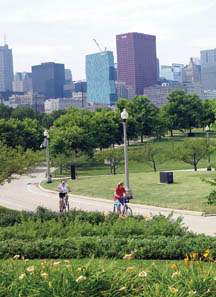
A woman (in red) riding a rent-a-bike

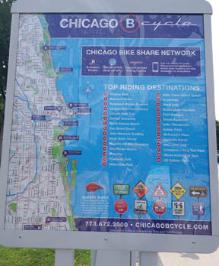
A sign posted at a cycling station in
Chicago
Chicago
bike, a hybrid, something between a road bike and a comfort bike. I optioned for a broader seat and added a stand and two
wheel covers. Only later when I was passed by on the trail by those serious-looking cyclists dressed in Spandex gear,
shouting “On your left!” did I realize why they mount nothing extra on their bicycles.
Having always been competitive, I tried to follow these cyclists at the beginning, only to be left behind in a matter of minutes,
gasping for air. I humbly accepted my defeat and settle for “my personal best,” an over-used phrase by Americans for
settling with the results of their endeavors, no matter how pitiful the “best” could be. I’ve learned to enjoy the scenery instead
of focusing on my humiliation.
It is always beautiful along the trail, with the ocean-like lake reflecting a different color every time I pass by, from blue, green
to gray, as if under the influence of the water’s different moods. The landscape along the trail changes as well, starting with
the tender green in the spring, followed by full blooms from fruit trees and plants, to the deep green in the summer, a variety
of red and yellow in the fall, and eventually to the bare structure of the tree trunks and branches in the winter. I usually start
bicycling in the spring and hang up my bike in November when the strong winds begin to whip my face and hurt my ears and
nose. But from my lakefront window in the condo, I can see those die-hard cyclists racing by on the trail all year round. I
salute them with genuine admiration.
wheel covers. Only later when I was passed by on the trail by those serious-looking cyclists dressed in Spandex gear,
shouting “On your left!” did I realize why they mount nothing extra on their bicycles.
Having always been competitive, I tried to follow these cyclists at the beginning, only to be left behind in a matter of minutes,
gasping for air. I humbly accepted my defeat and settle for “my personal best,” an over-used phrase by Americans for
settling with the results of their endeavors, no matter how pitiful the “best” could be. I’ve learned to enjoy the scenery instead
of focusing on my humiliation.
It is always beautiful along the trail, with the ocean-like lake reflecting a different color every time I pass by, from blue, green
to gray, as if under the influence of the water’s different moods. The landscape along the trail changes as well, starting with
the tender green in the spring, followed by full blooms from fruit trees and plants, to the deep green in the summer, a variety
of red and yellow in the fall, and eventually to the bare structure of the tree trunks and branches in the winter. I usually start
bicycling in the spring and hang up my bike in November when the strong winds begin to whip my face and hurt my ears and
nose. But from my lakefront window in the condo, I can see those die-hard cyclists racing by on the trail all year round. I
salute them with genuine admiration.
With the city’s promotion of “Ride Your Bike to Work,” I gradually
ventured out to the busy streets with my bike, first on broader
sidewalks, and then along the car lanes, feeling encouraged by the
increased number of cyclists on the streets. Over the last five years
since I’ve moved downtown, I’ve seen the changes in the city in
endorsing bike riding, which fits well with many people’s choice of
lifestyle, namely, saving the environment, living healthier and
reducing traffic. With the economic recession and the price of gas
going up, more people have turned to bicycling as a means of
transportation to work or recreation. Not only that, public
transportation such as the city bus, subways, and even Metro trains
that take commuters from the suburbs to the city, all allow bicycles on
board. My attention is always drawn to a bus when the front rack that
can accommodate two bicycles has one or two bikes, and its owner
claims the bicycle back whenever he or she is ready to ride again.
Except during rush hours, cyclists can take their bikes on the subway
ventured out to the busy streets with my bike, first on broader
sidewalks, and then along the car lanes, feeling encouraged by the
increased number of cyclists on the streets. Over the last five years
since I’ve moved downtown, I’ve seen the changes in the city in
endorsing bike riding, which fits well with many people’s choice of
lifestyle, namely, saving the environment, living healthier and
reducing traffic. With the economic recession and the price of gas
going up, more people have turned to bicycling as a means of
transportation to work or recreation. Not only that, public
transportation such as the city bus, subways, and even Metro trains
that take commuters from the suburbs to the city, all allow bicycles on
board. My attention is always drawn to a bus when the front rack that
can accommodate two bicycles has one or two bikes, and its owner
claims the bicycle back whenever he or she is ready to ride again.
Except during rush hours, cyclists can take their bikes on the subway
| An automated cycling station by the Field Museum |
or the trains. Today, Chicago boasts more than 12,000 bicycle racks throughout the city, over 110 miles of bike lanes, and
240 miles of signed bike routes. It’s fair to say that bicycle riding has become a social movement, a return to humanity,
simplicity of living, and love of exercise. It certainly benefits America’s battle against obesity.
This movement is not only taking place in Chicago, but also in many other metropolitan areas such as San Francisco,
Portland, Washington D.C., and New York City. Yes, even New York City! Self organized activities such as Critical Mass or
Night Rides are also gaining ground, claiming the city streets with thousands of bikers to spread the message. Organized
events are gaining popularity as well. In Chicago alone, several major biking events are held each year, closing Lakeshore
Drive or Columbus Avenue, main arteries of the city, to showcase the mass of cyclists. A truly magnificent sight.
Other programs like bike renting are also springing up around the country. With a membership and minimum fee, people
can rent bikes at different locations in a city by the hour and drop them off at a station most convenient to them when they are
done. In cities that have implemented such programs, automatic bike stations are set up all over the place, making it very
user friendly. Even in European cities such as London and Paris such programs are successfully run and are gaining more
popularity.
Of course, riding a bike on busy city streets can be dangerous. Last October, a block from a gym where I had scheduled a
massage, I had my share of pain. Hitting an unlevel joint of two pieces of concrete, I was thrown off my bicycle. I flew toward
the right of the sidewalk while my bicycle glided to the left. The hard landing ripped open my blue jeans and scratched off a
240 miles of signed bike routes. It’s fair to say that bicycle riding has become a social movement, a return to humanity,
simplicity of living, and love of exercise. It certainly benefits America’s battle against obesity.
This movement is not only taking place in Chicago, but also in many other metropolitan areas such as San Francisco,
Portland, Washington D.C., and New York City. Yes, even New York City! Self organized activities such as Critical Mass or
Night Rides are also gaining ground, claiming the city streets with thousands of bikers to spread the message. Organized
events are gaining popularity as well. In Chicago alone, several major biking events are held each year, closing Lakeshore
Drive or Columbus Avenue, main arteries of the city, to showcase the mass of cyclists. A truly magnificent sight.
Other programs like bike renting are also springing up around the country. With a membership and minimum fee, people
can rent bikes at different locations in a city by the hour and drop them off at a station most convenient to them when they are
done. In cities that have implemented such programs, automatic bike stations are set up all over the place, making it very
user friendly. Even in European cities such as London and Paris such programs are successfully run and are gaining more
popularity.
Of course, riding a bike on busy city streets can be dangerous. Last October, a block from a gym where I had scheduled a
massage, I had my share of pain. Hitting an unlevel joint of two pieces of concrete, I was thrown off my bicycle. I flew toward
the right of the sidewalk while my bicycle glided to the left. The hard landing ripped open my blue jeans and scratched off a
large patch of skin from my left knee and elbow. I
regretted having turned on to the side walk.
However, the marked bicycle path on the street
disappeared without a trace, as is the case for many
marked trails, making me nervous to race with the
passing cars. I was distracted while making the
shift. Angry at my own carelessness, I limped to the
gym, cleaned my wounds, and had my massage.
The pains from my left knee shot up my spine all the
time, turning a treat of comfort into an agony.
Lesson learned. I’m much more careful now on my
bicycle, whether I’m riding along an open trail or on
a busy street. I still love to ride and hope more
people will share the fun. Reportedly, The European
Union is considering limiting certain major city
areas in Europe to non-motor vehicles by 2030. That
would be a bicycle heaven.
regretted having turned on to the side walk.
However, the marked bicycle path on the street
disappeared without a trace, as is the case for many
marked trails, making me nervous to race with the
passing cars. I was distracted while making the
shift. Angry at my own carelessness, I limped to the
gym, cleaned my wounds, and had my massage.
The pains from my left knee shot up my spine all the
time, turning a treat of comfort into an agony.
Lesson learned. I’m much more careful now on my
bicycle, whether I’m riding along an open trail or on
a busy street. I still love to ride and hope more
people will share the fun. Reportedly, The European
Union is considering limiting certain major city
areas in Europe to non-motor vehicles by 2030. That
would be a bicycle heaven.